Case study 02 / 15 ⸺ Unilytics ⸺ 2025
Raising the Bar.
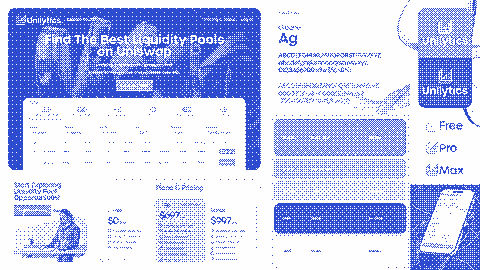
Liquidity pool data was spread across analytics sites and spreadsheets, and most of it assumed you already spoke DeFi. I designed Unilytics from scratch, the brand and the product, around a pool explorer you browse by pair type. It launched in 2025 and now has hundreds of paying users.

The brief
Make DeFi feel approachable.
Unilytics is a FutureCraft product: an analytics tool for people who provide liquidity on Uniswap. When I started it had a name, but no logo, interface or product yet. I was the brand and product designer, working with the FutureCraft team from the first sketch to launch.
There were already liquidity pool trackers out there. Our bet was to do the same job at a price that was competitive and easy to understand, for people who find blockchain investing complex and technical. The brand had to feel approachable in a space that rarely tries to be. It also had to feel like one place to go for pool analytics.
Approachable, in a space that loves to be complicated.
Sketches
Seven Us on paper.
It started in pencil. Seven rough marks, most of them some version of a U: a split ribbon, a U stacked with bars, a heavy italic, a U built from parallel lines, a cube, an eye and a folded U. Two of them became the first concepts. A third got its turn later.
Round 1
Two concepts and a Loom.
I sent the team two concepts, Twinflow and Rubik, with a five-minute Loom walking through the thinking behind each one.
A · Twinflow
Two halves of a U, blue and teal, coming together as one shape. They trade curves with each other, and the serifs point up like arrows.
Concept A · Twinflow
§ 04
B · Rubik
The complexity of crypto packed into a simple, organized cube. The color spectrum stands for the variety of coins, and a U sits in the middle. I pushed this one the furthest, trying it as a U monogram, as an upward arrow and as a nod to the pixel-built FutureCraft logo.
Concept B · Rubik
“I could watch your branding videos all day... the details you are able to think of and incorporate is unbelievable.”
*Justin McCormick, FutureCraft, on the concept walkthrough
The call
“Concept A is a winner, but…”
Andy Proper came back the next day: “Concept A is a winner, but we would like to explore this one as well please.” This one was the U made of bars, one of my pencil sketches that hadn’t made the first round. I was about to take some time off, so I said I’d flesh it out when I got back.
Round 2
A U made of bars.
When I got back, I sent it over as a somewhat animated moodboard, with a three-minute Loom. The walls of the letter hold a row of bars that climb from left to right, so the mark says analytics before you get to the name. It went from a pencil sketch to a clean blue mark and a lockup with the wordmark. The team went with it, and it became the Unilytics brand.
Around it: Urbane for type, a set of blues named after market caps (brand blue, mid cap and low cap), and a deep navy called Space. The plan badges use the mark too. The bars fill in as the tier goes up.
Concept C · Bars
Rollout
The prototypes get a brand.
The product work had already started. The desktop prototypes existed before the brand did, so I applied the new brand and styles to them and moved on to the How It Works graphics for the homepage. Mobile came next: filtering and viewing explorations for Explore Pools, then a full mobile prototype.
I designed everything on Untitled UI, which ships a matching React component library. I flagged it to the developers so they could build from the same components I designed with. That turned into a conversation about wiring it into our design system: Tailwind, CSS variables and dark mode.
The product
Browse by pair type.
Thousands of pools in one table is a lot to ask of someone new. So the pool explorer opens on a question anyone can answer: what kind of pair do you want to hold? Stablecoin/Stablecoin, BTC/Stablecoin, ETH/Stablecoin, ETH/BTC, Altcoin/Stablecoin or ETH/Altcoin. Pick one and the table narrows to pools of that kind. The pair types run roughly from safest to riskiest, from left to right.
The filters come after that: protocol, network, fee tier, TVL, volume, market cap and a keyword search. Of everything in the product, this is the part I’m proudest of.
Free and Pro
Show the line between free and paid.
The pricing had to be easy to understand, so the product shows you where the line is. Anyone can browse every pool. The deeper columns, like 7- and 30-day APR, and the Analyze button sit behind one panel that tells you what you’d get and offers a demo video before it asks for money.
Explore Pools, before and after upgrading.
The analyzer
From "what if" to a position.
Hit Analyze on any pool and you get its price history with a range you can drag, plus min and max prices and a deposit amount. It shows the estimated fees per day that range would earn. Change the range and the number updates. The last step, Create This Position, links out to open the position.
The homepage
We crunch the data, so you can optimize your returns.
The marketing site says it in two beats. First what Unilytics does: it pulls in Uniswap trade data from Ethereum, Base, Arbitrum, Optimism, Unichain and more. Then what that gets you: finding profitable pools faster and running range-based APR projections before you commit.
After
Live in 2025.
Unilytics launched in 2025 with a free tier and Pro, covering Uniswap v3 and v4 across Ethereum and four other networks. Today, hundreds of people pay for it. The reviews on the site read like the brief handed back to us.
- Active paying users 100s
“Before this I was opening like 10 tabs between Uniswap analytics sites and spreadsheets. Unilytics basically put everything I needed in one place.”
*Lucas Meyer, Unilytics user
Michael Turner: “Honestly I was kinda overwhelmed by liquidity pools before finding Unilytics. Now I can actually sort through pools fast and figure out what’s worth looking at without going down a 3 hour rabbit hole.”
Liam Thompson: “The estimated daily income feature made liquidity pools finally ‘click’ for me. Seeing the numbers update live when I changed ranges helped me understand LP’ing way better.”